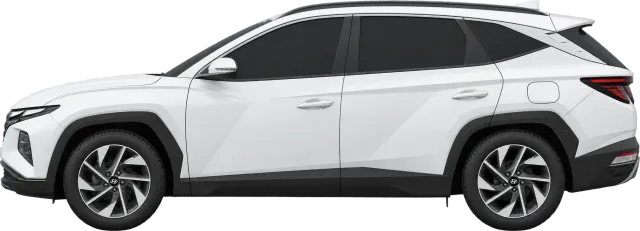
Hyundai Tucson
Passengers 5 · Petrol · Premium SUV
The Skoda Karoq is a premium SUV with a 521-litre boot, blind-spot detection and adaptive cruise control - two systems that most cars in our category do not have.
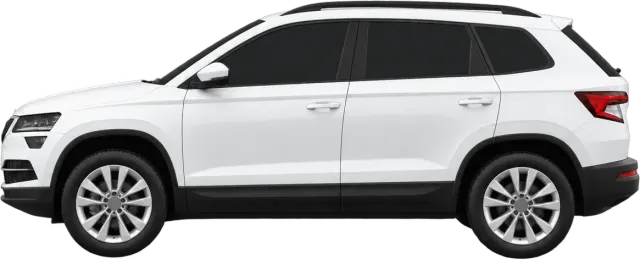
The Karoq is a leisure vehicle 4,390 mm long - about 12 centimetres shorter than the Tucson, and you feel it when parking. The boot is 521 litres.
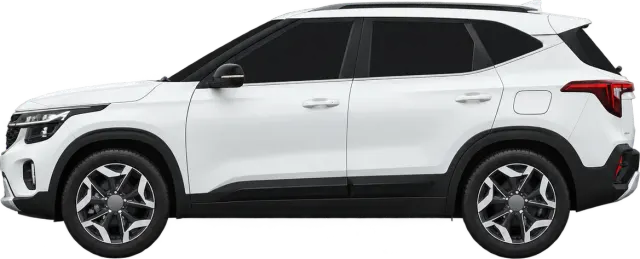
What sets it apart in our category is the equipment: it is registered with both blind-spot detection and adaptive cruise control. The Hyundai Tucson and the Kia Seltos in the same category are not registered with either.
The engine is a 1,498 cc petrol engine with 150 horsepower, with an automatic gearbox and front-wheel drive. CO2 emissions are 149 grams per kilometre and the pollution group is 14. A towing capacity of 1,500 kg braked and 690 kg unbraked.
The remaining equipment: 7 airbags, automatic emergency braking, lane departure warning, forward collision warning, reversing camera, stability control and tyre pressure sensors. Pedestrian detection and automatic high beam are not registered for the model.
Main audience
Adaptive cruise control keeps the distance by itself, and blind-spot detection helps when changing lanes. In a wide leisure vehicle, this is exactly where those systems make a difference.
521 litres at the back, through a tall, wide opening of a leisure vehicle. For a family's suitcases, that is definitely enough.
4,390 mm - about 12 cm shorter than the Tucson in the same category. With a reversing camera, parking is easier than in a large leisure vehicle.
A respectable leisure vehicle with high seating and room for equipment, and a towing capacity of 1,500 kg according to the Ministry of Transport.
Less suitable
521 litres is good, but the Hyundai Tucson in the same category gives 598. If luggage is the deciding consideration, that is a difference of almost 80 litres.
Blind-spot detection and adaptive cruise control
Both systems are registered for the model with the Ministry of Transport - and the other two SUVs in our category are not registered with either.
Shorter than most of the category
4,390 mm. In city parking and in an underground car park, that is the difference against a full-size leisure vehicle.
A towing capacity of 1,500 kg
Braked; 690 kg unbraked. Among the highest in our category.
No pedestrian detection
Automatic emergency braking is registered, but pedestrian detection is not registered for this model - unlike most of the other cars in the fleet. In city driving that is a difference worth knowing.
No automatic high beam
It is not registered for the model. On a dark intercity road you switch manually.
Less luggage than the Tucson
521 litres against 598. In a category where people choose by room, that is the main gap.
Specification data is based on the Israel Ministry of Transport vehicle model registry. Verified 5 September 2026. Individual cars may differ.
Both are in the Premium SUV category. The Tucson is bigger and has a bigger boot (598 against 521 litres); the Karoq is shorter and therefore easier to park, and is registered with blind-spot detection and adaptive cruise control, with which the Tucson is not registered. For a long trip the Karoq is better equipped; for luggage the Tucson is bigger.
Our car is registered as front-wheel drive (4X2). It is a leisure vehicle for the road and the city, not an off-road vehicle.
The registered towing capacity is 1,500 kg braked and 690 kg unbraked. Actual towing requires a fitted tow hook and a suitable licence - see the cars with a tow hook.
Yes. Mention the model in the booking notes or call the branch, and we will do our best to match. Availability changes from day to day, so a call to the branch before pick-up is the safe way to confirm.