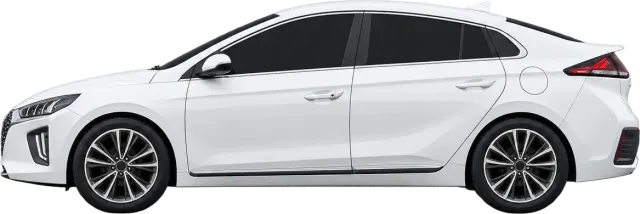
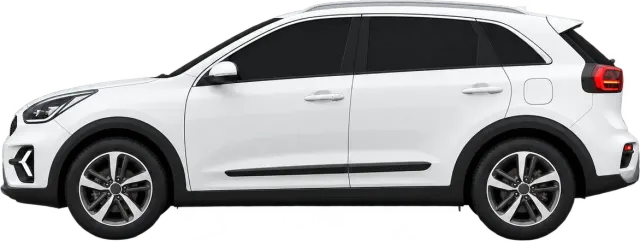
Kia Niro
Passengers 5 · Hybrid · Hybrid Crossover
The Toyota C-HR Hybrid is a styled crossover with outstanding fuel economy - 86 grams of CO2 per kilometre - a 377-litre boot, adaptive cruise control and a reversing camera.
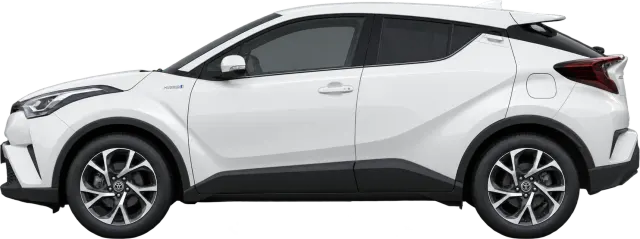
The C-HR is a crossover with a sloping roofline and small rear windows - a design that looks different from any other car in the category, and that is usually the reason people choose it. Consumption is the second figure that stands out: 86 grams of CO2 per kilometre and pollution group 4. Of all the cars we run, only the Toyota Auris is more economical.
The drive: a 1,798 cc petrol engine with an electric motor, and an automatic gearbox. There is nothing to plug in. The boot is 377 litres. The registered towing capacity is 725 kg, braked and unbraked.
The safety equipment according to the Ministry of Transport: 7 airbags, automatic emergency braking with pedestrian detection, adaptive cruise control, lane departure warning, forward collision warning, reversing camera, automatic high beam, stability control and tyre pressure sensors.
Main audience
86 grams of CO2 per kilometre in a crossover is a figure that much smaller cars do not reach. On a long daily drive the difference adds up.
The design is the main reason to choose the C-HR. If how the car looks in the car park matters to you, this is the car in the category.
Adaptive cruise control keeps the distance by itself, and automatic high beam handles a dark road - together with the low consumption, a long trip comes out cheap and comfortable.
In stop-start driving the electric motor does a large part of the work. The car is quiet and very economical in exactly this situation.
Less suitable
The sloping roofline and the small rear windows exact a price: the back seat feels closed in, and 377 litres is less than most crossovers. If it is a family trip with luggage, the Kia Niro or the Skoda Karoq will suit better.
Among the most economical in the fleet
86 grams of CO2 per kilometre and pollution group 4. Only the Toyota Auris is lower than that with us, and that is in a crossover.
Adaptive cruise control and automatic high beam
Together with emergency braking, pedestrian detection and a reversing camera, according to the Ministry of Transport registration for the model.
A hybrid with no charging point
The battery is charged from driving and from braking. You refuel with ordinary petrol and there is nothing to plan.
Limited rear visibility
The rear window is small and the roofline slopes - that is the price of the design. There is a reversing camera, but when changing lanes and in parallel parking you feel it, and there is no blind-spot detection.
The back seat feels closed in
The small rear windows and the low roof create a closed-in feeling in the back. For children it is fine; an adult on a long trip will feel it.
377 litres, less than most crossovers
Enough for a couple with suitcases, less for a family with equipment. Here too the design comes at the expense of volume.
Specification data is based on the Israel Ministry of Transport vehicle model registry. Verified 5 September 2026. Individual cars may differ.
Both are hybrid crossovers in the same category, but opposite in character: the C-HR is styled, lower and very economical (86 grams of CO2), but with limited rear visibility; the Niro is boxier, with good visibility and better-used interior space. If design matters - C-HR; if comfort and visibility - Niro.
No. It is an ordinary hybrid - the battery is charged by the engine and by braking while you drive, and you only refuel with petrol.
377 litres with the seats up. That is enough for a couple with suitcases, but less than most crossovers of similar size.
Yes. Mention the model in the booking notes or call the branch, and we will do our best to match. Availability changes from day to day, so a call to the branch before pick-up is the safe way to confirm.